You’ve inherited a ring, found a broken necklace in a drawer or finally decided to investigate that bracelet your ex bought you.
You turn it over and spot some tiny numbers and letters. Is that 375? An anchor? And whose initials are those?
Before you start mentally spending the money (tempting, we know!), here’s what those little marks actually mean.
A genuine gold hallmark confirms that an item has been independently tested for its precious metal content. Its marks help identify the gold’s purity, who submitted it for testing and the assay office responsible.
But there’s something worth knowing before you start checking your jewellery: older gold won’t always have the same marks as a piece bought today.
At PostGoldForCash, plenty of the jewellery arriving at our Dorset HQ has been passed down through families. We regularly see older carat marks and gold grades that don’t appear in modern hallmarking guides. That doesn’t mean there’s anything wrong with them.
What do the numbers on gold jewellery mean?
Numbers such as 375, 585 and 750 describe how much gold is in the metal, measured in parts per thousand. A genuine 375 gold fineness mark, for example, represents 9ct gold containing 37.5% gold.
Older jewellery may show the carat number instead, or use a decimal mark such as .375. You might find both together. Here are some common marks, including a couple worth looking for on inherited pieces:
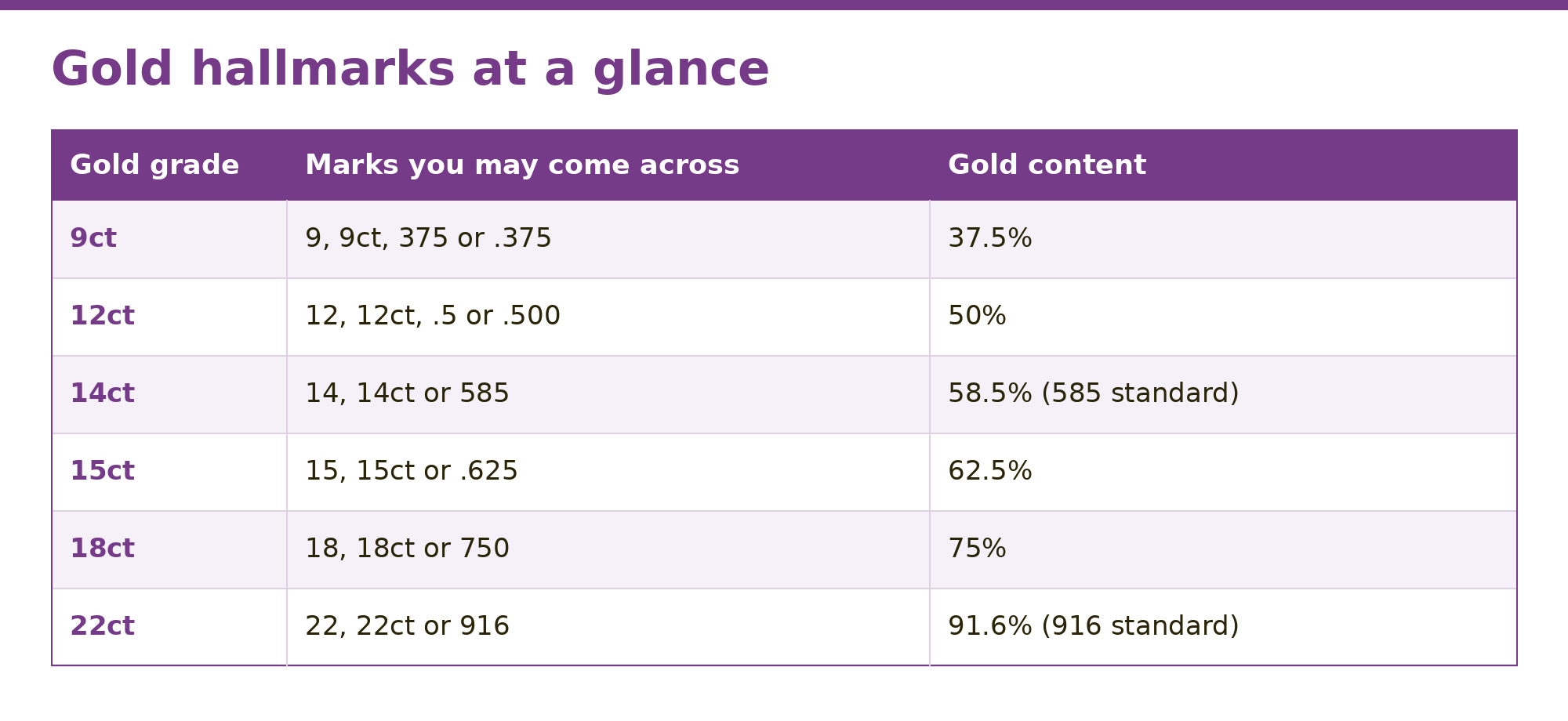
These are clues to the gold grade, rather than a guarantee that any individual stamp is genuine. The other marks and, where necessary, testing help establish what you have.
Those other metals help give jewellery its strength and colour. Gold jewellery doesn’t have to be pure gold to be worth something.
And no, 375 isn’t what someone paid for it. Nice idea, though.
Why does older gold have different marks?
Hallmarking has changed over the years, so your nan’s wedding ring may look different from something in a jeweller’s window today.
The UK introduced the 9ct, 12ct and 15ct gold standards in 1854. Older pieces can carry carat numbers alongside decimal marks such as .375, .500 and .625.
The Hallmarking Act 1973 brought changes into effect in 1975, including the wider use of numerical fineness marks. From 1999, these numbers became compulsory on UK gold hallmarks.
That means an older 9ct piece may show a carat mark rather than the 375 you expect. An older 22ct wedding band may carry a 22 or 22ct mark rather than 916. Some manufacturers continued using traditional carat markings while these were permitted, including on vintage-style designs.
The important bit? Don’t dismiss a piece simply because its marks don’t match a modern chart.
What if my jewellery says 15ct or 12ct?
These are older gold grades that are less familiar today.
At PostGoldForCash, we typically buy 15ct gold every week. It contains 62.5% gold and may be marked 15ct or .625. We also occasionally receive the much rarer 12ct gold, containing 50% gold, with marks such as 12ct, .5 or .500.
The UK discontinued the 12ct and 15ct hallmarking standards in 1932, replacing them with 14ct. That’s why they may be missing from guides focused on modern jewellery.
If you find one of these marks on a family piece, it’s worth having it checked rather than assuming the number is wrong.
What do 583 and 333 mean?
Jewellery bought abroad can carry different purity stamps too. You may come across 583, often associated with older Russian or Soviet 14ct gold. It indicates 58.3% gold.
Another is 333, commonly associated with German 8ct gold, indicating 33.3% gold.
These stamps are useful clues, but they aren’t complete UK hallmarks on their own. A number alone also won’t confirm where a piece was made or guarantee its gold content.
If you’re unsure, let our team know what you’ve found. Testing can establish the gold grade.
Is a number stamp the same as a hallmark?
Not quite. A complete modern UK hallmark has three compulsory parts: a sponsor’s mark, a metal and fineness mark, and an assay office mark.
The sponsor’s mark identifies the person or business that submitted the item for hallmarking. That could be a manufacturer, retailer or importer, so it doesn’t necessarily identify who made it.
The metal and fineness mark tells you the precious metal and how pure it is. The outline around the number helps identify the metal too.
The assay office mark identifies the office responsible for testing and hallmarking it.
A lone “375” or “18ct” stamp gives you something to investigate, but it isn’t a complete modern UK hallmark on its own.
Older British jewellery can have different combinations of marks. The modern three-mark guide is a starting point, rather than a checklist every inherited piece must match.
What does the anchor mean?
An anchor is Birmingham Assay Office’s mark. It identifies the assay office, rather than where the jewellery was made.
So an anchor on an inherited ring doesn’t mean your nan bought it on a cruise. Cute image though!
Can a hallmark tell me how old my jewellery is?
Sometimes, but there’s a detail worth knowing.
Some hallmarks include a date letter. This records the year the item was hallmarked, which isn’t necessarily the year it was made.
The letter’s style and surrounding shape matter when identifying the date. Searching “ring with letter B” and picking the first result could send you down the wrong path.
Date letters have been optional since 1999, so their absence doesn’t mean a modern hallmark is incomplete.
If you’re researching a family piece, keep any receipts, old valuations or notes that came with it. They may help you build a fuller picture.
My jewellery has no hallmark. Does that mean it’s fake?
No. A missing hallmark doesn’t automatically mean an item isn’t gold.
For example, gold articles weighing less than 1 gram are exempt from compulsory hallmarking. Age and other exemptions can also be relevant.
Jewellery bought abroad may use a different marking system. Recognised Convention hallmarks from other member countries are accepted in the UK, so unfamiliar marks aren’t automatically a warning sign either.
Equally, no mark doesn’t prove that it is gold. If you’re unsure, have the metal tested rather than guessing.
At PostGoldForCash, we test unhallmarked items to establish their gold grade. We don’t pay a lower rate simply because gold has no hallmark.
Why does my gold-coloured ring say 925?
This one can catch people out.
925 is the fineness number used for sterling silver, meaning 92.5% silver. A gold-coloured piece marked 925 may be gold-plated silver rather than gold alloy throughout.
Gold-plated silver is hallmarked as silver. The plating doesn’t turn the whole ring into 18ct gold, even if that is the purity of the coating.
The same goes for descriptions such as “gold vermeil” or “silver gilt”. These refer to gold-plated silver, rather than solid gold jewellery.
If your piece is marked 925 but looks gold, contact our team before sending it so we can confirm whether it meets our buying criteria.
How can I check the marks without damaging anything?
Start with good light and a magnifying glass. Hallmarks can be very small.
Common places to look include the inside of a ring’s band, near a necklace or bracelet clasp and on the back of a pendant. The exact position varies and marks can become difficult to read through wear.
Take a clear photograph of the marks and another of the whole item. It’s easier to ask for help when someone can see both.
Resist the temptation to scratch, file or attack it with a home testing kit, especially if it’s inherited jewellery. Let someone experienced examine it first.
Does a higher carat mean my jewellery is worth more?
Higher-carat gold contains more gold per gram. But a hallmark isn’t a price tag.
For scrap gold, both the gold grade and the weight matter. At PostGoldForCash, our valuers separate different metals and grades, test where necessary and weigh the items before making an offer.
There’s another question with inherited jewellery: could the piece have value beyond its metal?
If you think you have an antique, a signed designer piece or something unusual, consider getting a specialist jewellery valuation before selling it as scrap. It’s worth understanding what you have first.
And if you love it, keep it. Finding out what a hallmark means doesn’t commit you to selling anything.
Ready to find out what those forgotten bits could be worth?
Whether it’s an odd earring, a broken chain or a gift that has outlasted the relationship, you don’t need to become a hallmark expert before speaking to us.
If you’re happy to let it go, request your free gold selling pack. Our team will assess your items and contact you with an offer.
You decide whether to accept. If you choose not to sell, we’ll return your items free of charge.
Follow us >> Instagram.com/PostGoldForCash / Facebook.com/postgoldforcash / TikTok.com/@postgoldforcash